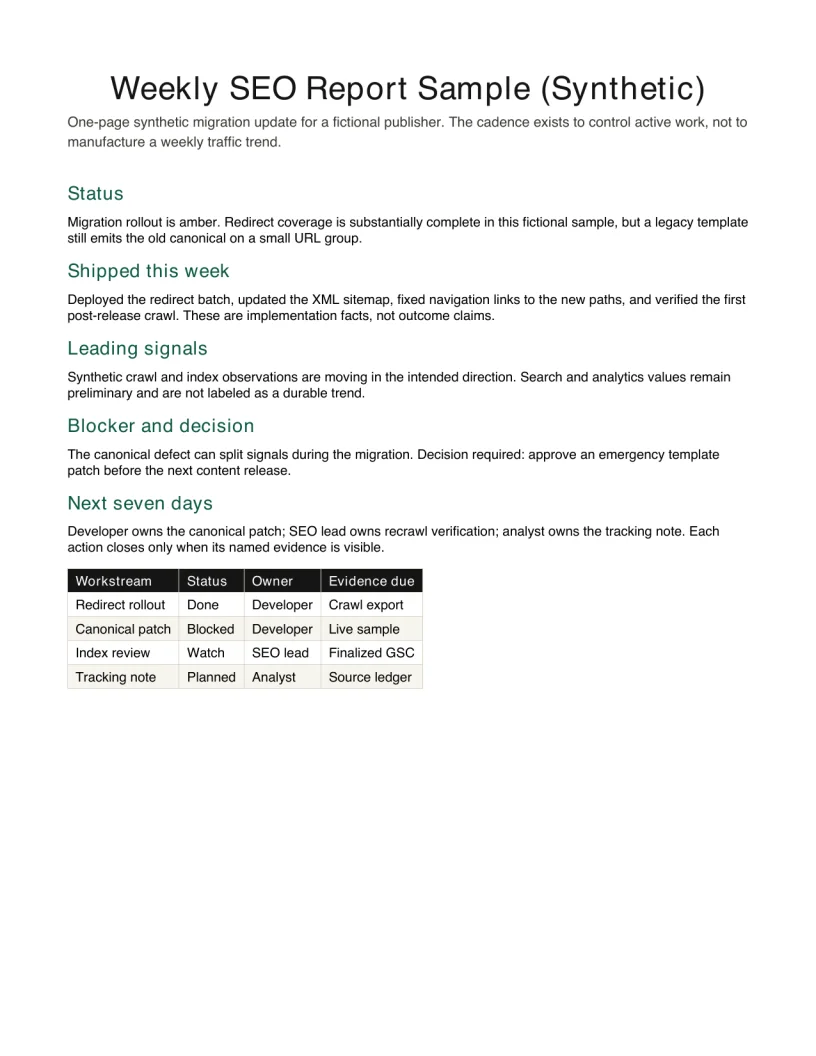
 Actual first page · synthetic PDF
Weekly SEO report sample
This synthetic report shows a concise operational update for an active launch, migration, or delivery sprint. It includes work shipped, leading signals and blockers, next-week owners and can be downloaded as a PDF. Use it as a structural reference, not as real client data. Use when stakeholders need a seven-day decision record between monthly reports.
- Best for
- Use when stakeholders need a seven-day decision record between monthly reports.
- File
- Complete PDF with a real first-page preview
- Boundary
- Fictional business and synthetic evidence; not a case study or site performance
- Next step
- Replace the structure with verified inputs in the matching template or generator
When a weekly SEO report is justified
A weekly SEO update is useful during a migration, launch, incident, or tightly managed experiment where seven days of work changes the next decision. It is not a compressed monthly report. This synthetic example covers a fictional site migration and keeps the document to one operational page: what shipped, the leading signals, the blockers, the approvals needed, and who owns the next seven days.
Weekly metrics are noisy, so the sample avoids declaring success from a small traffic movement. It labels provisional signals, compares like-for-like days when possible, and separates completed implementation from outcomes that need more time. The report earns its cadence by reducing coordination risk, not by filling a dashboard every Friday.
A one-page operational decision log
The report opens with the status of the migration and one decision required from the stakeholder. The shipped-work block lists only changes that can be verified in production. The signal block records crawl, index, and search observations with their collection dates. The blocker block names anything that could invalidate those observations, such as an incomplete redirect rollout or a tracking change.
The next-week plan is deliberately small. Each action has one owner, a due date, and the evidence that will close it. Work that does not affect the current launch or incident stays in the monthly backlog so the weekly update does not become a second project-management system.
- Use a weekly cadence only while short-term evidence changes the next action.
- Label search and analytics movements as preliminary until the reporting window is stable.
- Report implementation and outcome separately so shipped work is not mistaken for impact.
- Carry unresolved blockers forward with the same owner instead of rewriting them as new wins.
Fields in the weekly update
The sample fields keep the report accountable without adding ceremony. Status describes the workstream, evidence names the dated observation, confidence states whether the signal is stable, and decision required tells the stakeholder exactly what must happen next.
| Field | Purpose | How to use it |
|---|---|---|
| Status | The current state of the launch, migration, or incident. | Describe the workstream in one sentence and keep provisional outcome claims separate. |
| Dated evidence | The crawl, index, search, or analytics observation. | Name the source and collection date; label incomplete weekly data as preliminary. |
| Blocker or decision | What prevents progress or needs approval. | Keep unresolved blockers visible and state the exact stakeholder choice required. |
| Next-week owner | Accountability for the next seven days. | Assign one owner, due date, and observable completion evidence. |
Move from weekly control to monthly reporting
Create the update from the same verified source ledger used by the monthly report. Load only material findings into the SEO report generator, preserve caveats, and print the one-page output for the active workstream. Do not create a separate canonical page or dashboard for every week; the downloadable sample is a reusable format, while the client's dated reports remain private.
Once the launch stabilizes, stop the weekly cadence and roll the final verified outcome into the monthly report. That prevents preliminary numbers from being preserved as a permanent trend and gives the client one durable record of what changed, why, and what happens next.
Weekly SEO report sample FAQ
Should every SEO client receive a weekly report?
No. Monthly reporting is better for most retainers because search data needs time to stabilize. Use weekly updates during migrations, launches, incidents, or controlled experiments where the next seven days require a stakeholder decision.
What should a weekly SEO report include?
Keep it to status, work verified in production, dated leading signals, blockers or data caveats, one decision required, and a short next-week plan with owners. Put full keyword and crawl tables in a private appendix.
Are the figures in this weekly sample real?
No. The site, migration, dates, URLs, and measurements are synthetic. Replace them with verified evidence from your own deployment, crawl, analytics, and Search Console sources.
How do I avoid overreacting to weekly SEO data?
Label preliminary signals, compare consistent days and sources, and separate implementation from outcome. Do not rewrite a page or claim a trend from one incomplete week unless a technical defect is independently verified.
When should weekly reporting stop?
Stop when the launch, migration, or incident no longer needs a seven-day decision cycle. Roll the final verified outcome and remaining actions into the normal monthly report so the client has one durable record.