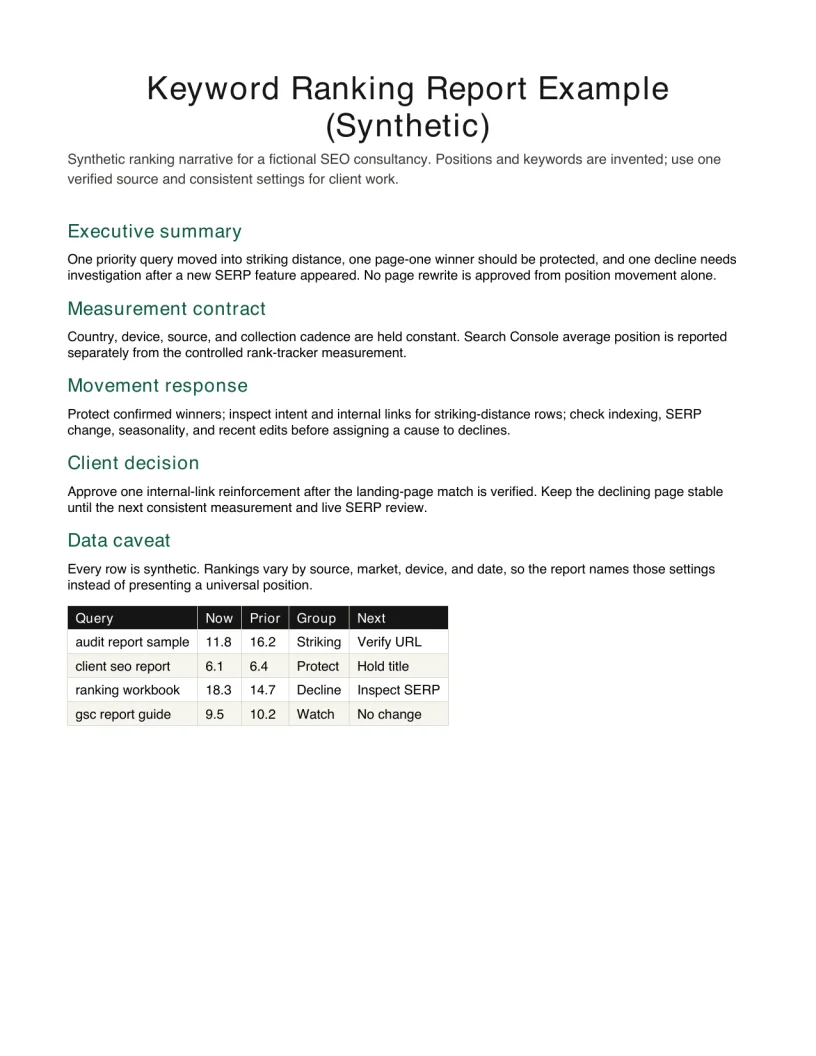
 Actual first page · synthetic PDF
Keyword ranking report example
This synthetic report shows a ranking-movement narrative that separates observed position changes from SERP context and next actions. It includes movement summary, SERP and confidence notes, owned next actions and can be downloaded as a PDF. Use it as a structural reference, not as real client data. Use when a client needs interpretation and priorities, not a raw rank-tracker export.
- Best for
- Use when a client needs interpretation and priorities, not a raw rank-tracker export.
- File
- Complete PDF with a real first-page preview
- Boundary
- Fictional business and synthetic evidence; not a case study or site performance
- Next step
- Replace the structure with verified inputs in the matching template or generator
A ranking report that explains movement
This keyword ranking report example shows how to turn a position table into a client decision. The fictional data covers a small set of priority queries across one market and device. Every keyword and metric is synthetic. The value is the reporting structure: each movement is paired with search intent, the ranking URL, a SERP observation, confidence, and a next verification step.
A position change is not a result by itself. Rankings vary by location, device, personalization, and measurement source, and they can move without producing qualified traffic. The report therefore uses ranking movement as an investigation signal, then connects it to verified Search Console clicks, impressions, and the client action that follows.
Four movement groups, four different responses
The sample separates winners, striking-distance queries, declines, and watch items. A winner is protected and documented rather than immediately rewritten. A striking-distance query triggers an intent and internal-link review. A decline triggers checks for SERP change, index status, seasonality, measurement consistency, and recent edits before anyone assigns a cause. Watch items stay stable until a larger sample confirms direction.
The executive summary does not total every upward and downward move. It identifies the three rows that change a decision: one page to protect, one opportunity to reinforce, and one loss to investigate. That keeps a 200-keyword export from becoming a 200-row client report.
- Record the same country, device, source, and date cadence for both periods.
- Name the ranking URL so the report can detect routing changes without claiming cannibalization automatically.
- Describe the visible SERP change before attributing movement to page edits.
- Tie the next action to evidence expected in the following reporting period.
Fields in the ranking narrative
The field map keeps raw observation and interpretation separate. Current and prior position show the measured movement; the SERP note records what changed around the result; confidence explains the sample strength; and the next action states what to verify or change. Leave a cell blank when the source does not provide it.
| Field | Purpose | How to use it |
|---|---|---|
| Keyword and ranking URL | The measured query and the page associated by the source. | Preserve source, country, device, and date settings so the comparison remains like-for-like. |
| Current and prior position | The observed movement between periods. | Keep missing measurements blank and do not compare Search Console average position directly with a rank tracker. |
| SERP note and confidence | Context around the movement and sample strength. | Record visible SERP changes and whether the movement is stable enough to change a decision. |
| Owner and next action | The verification or implementation step. | State what to protect, inspect, or change and the evidence expected next period. |
Build this report from verified sources
Use the keyword ranking workbook to normalize the source, location, device, and reporting windows. Add Search Console data where it is available, but do not treat average position as identical to a rank tracker measurement. If the ranking URL changes, inspect the query-by-page data before calling it cannibalization. Separate exports that lack that relationship cannot prove which page ranked for a query.
Move the few rows that affect a client decision into the SEO report generator. Preserve the source and caveat, assign an owner, and state the expected evidence. The finished report should tell the client what to protect, what to investigate, and what not to change yet.
Keyword ranking report example FAQ
Are the rankings in this example real?
No. Every keyword, URL, position, and movement is synthetic. Replace the sample with measurements from one named source, using consistent location, device, and date settings before making a client claim.
Should a client ranking report include every tracked keyword?
Usually not in the main narrative. Keep the full inventory in the workbook or appendix, then surface only the winners, striking-distance opportunities, meaningful declines, and rows that require a decision.
Can Search Console average position replace a rank tracker?
It answers a different question. Search Console reports impression-weighted average position for observed searches, while a rank tracker measures a controlled keyword, location, and device. Name the source and avoid comparing the two as if they were identical.
Does a ranking drop prove an SEO change failed?
No. Check measurement settings, seasonality, index status, SERP features, competitors, and recent site changes. A report should describe the observed movement and the next verification step before assigning causation.
What makes a ranking report useful to a client?
It should connect a small number of material movements to business intent, explain confidence and context, and end with owned actions. A long position table without interpretation belongs in an appendix, not the decision surface.