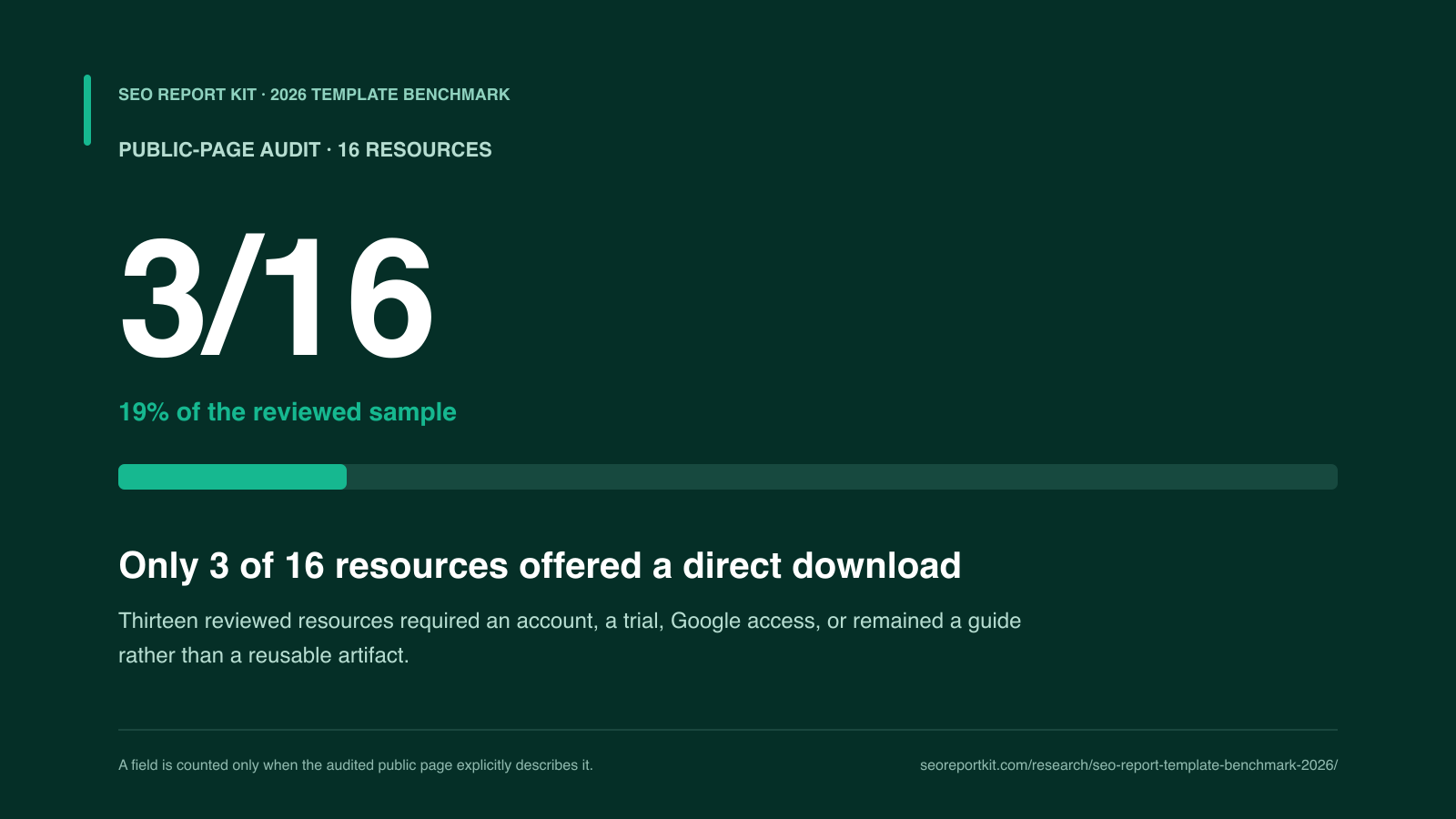
offered a direct download without an account.
SEO report template benchmark 2026
A public-page audit of access friction, reporting structure, workflow fields, and AI-search coverage across 16 SEO reporting resources.
Input: source-linked public resource pages. Output: an original CSV, four explanatory charts, and reproducible coding notes. Limit: a “no” means not documented on the audited public page; it does not prove a private product lacks the feature.
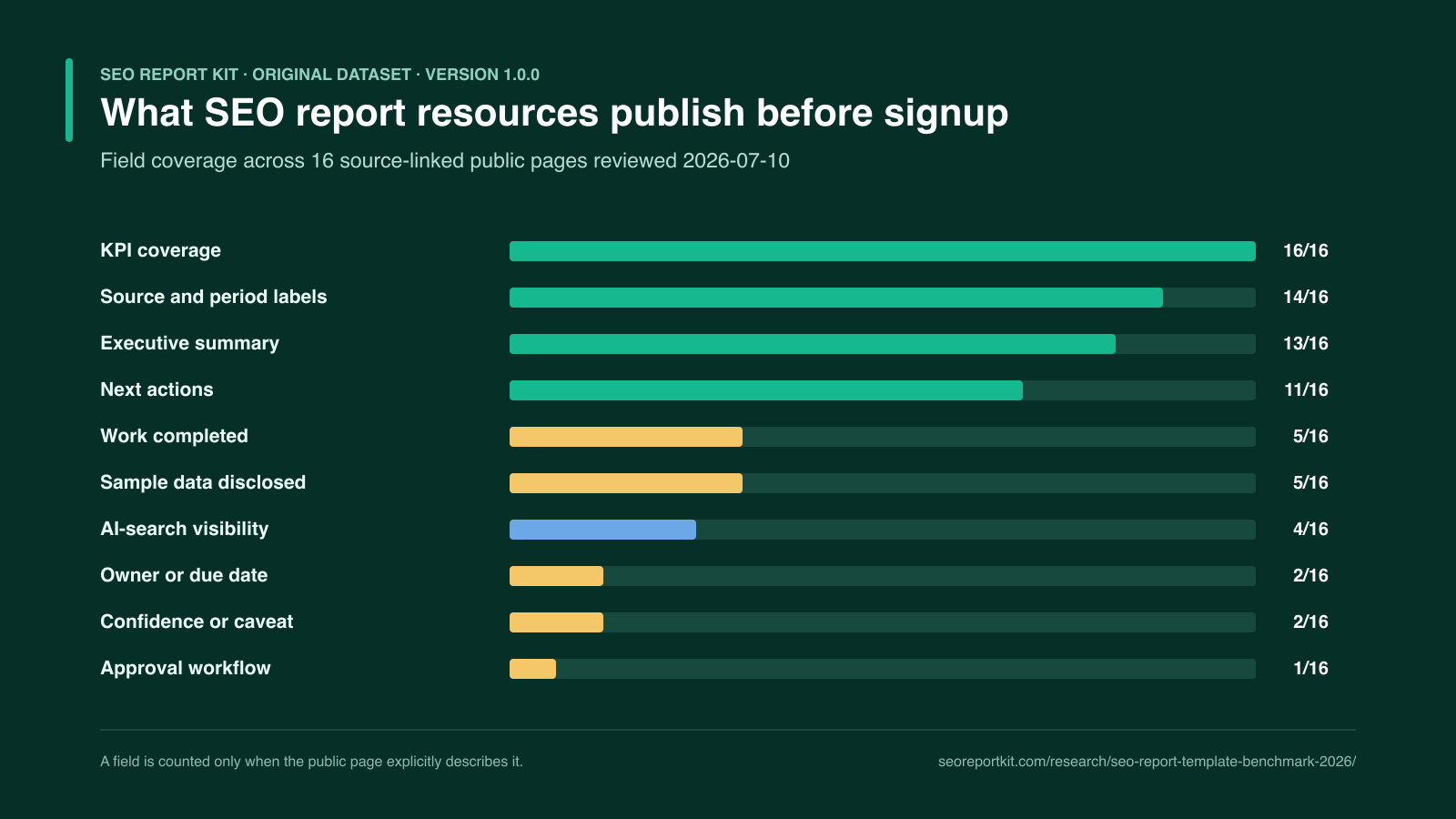
13/16
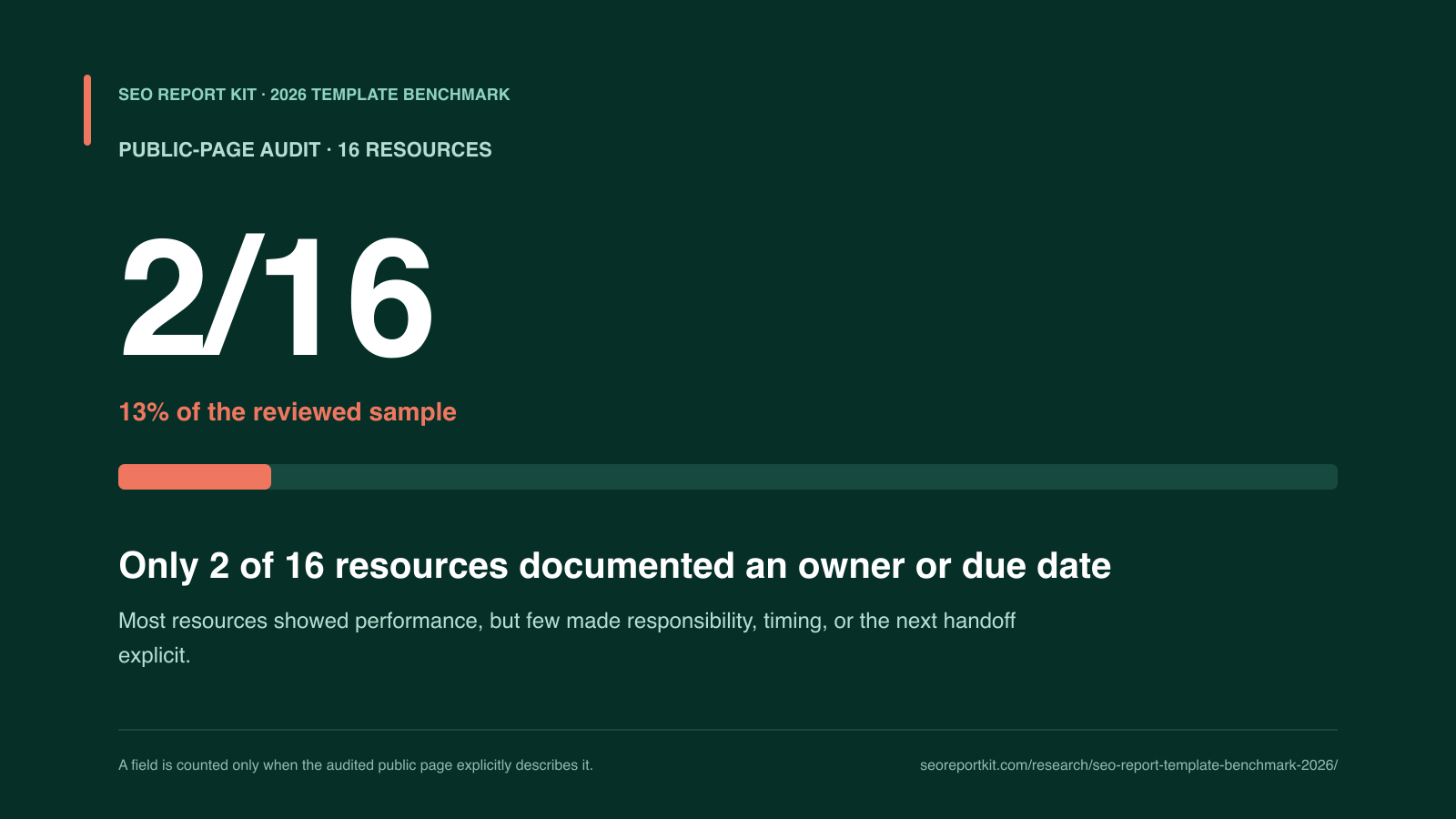
describe an executive summary, but only 2/16 explicitly describe an owner or due date.
explicitly include work completed or actions taken.
describe an owner, due date, timeline, or ETA.
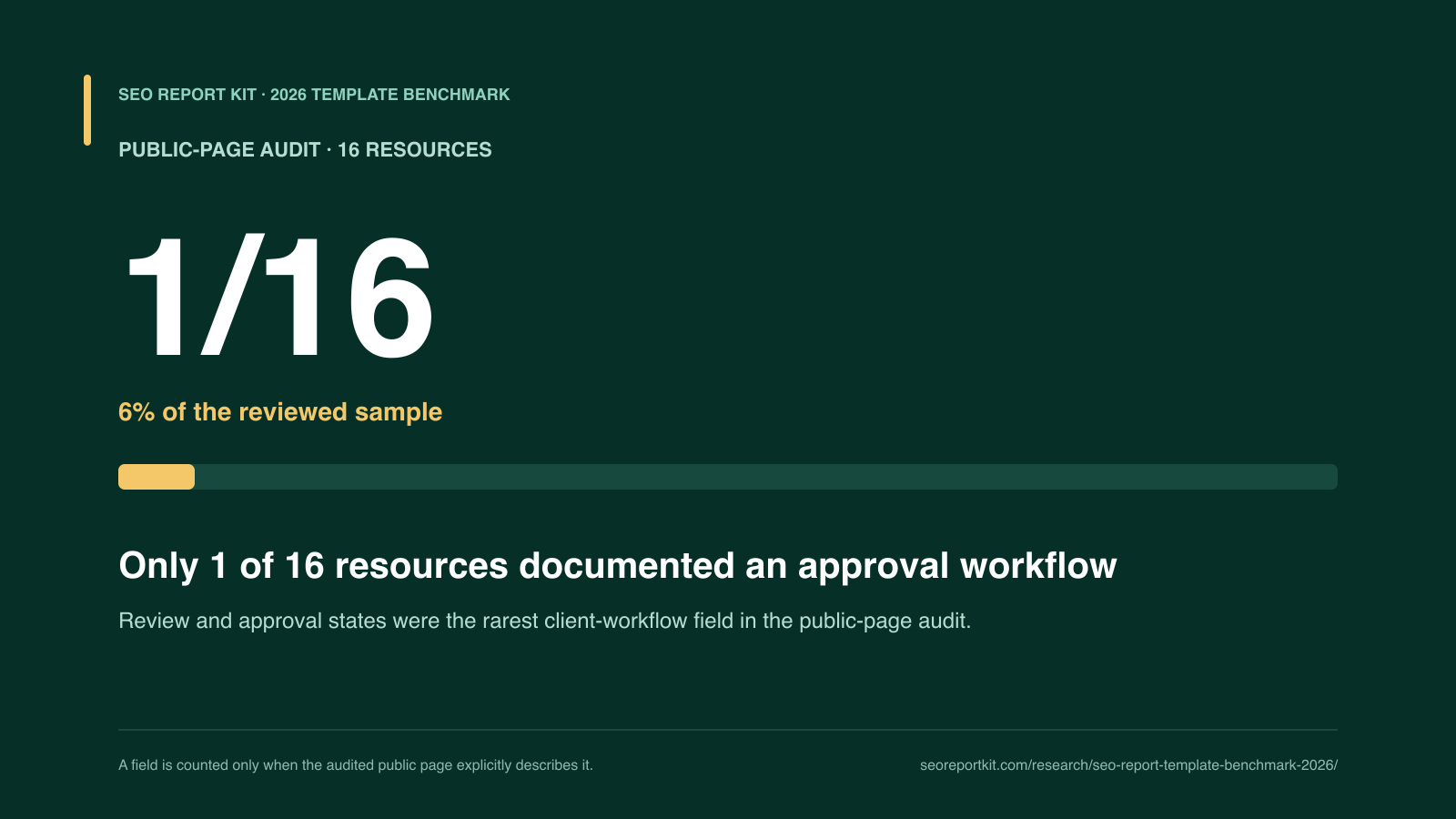
publicly describes a review or approval state.
Add workflow context, not another KPI chart
The rare fields in this audit are ownership, approval, caveats, and work completed. Use the editable report structure for those fields, then use the guide to keep each claim tied to a source and reporting period.
Field coverage
Performance fields are common. Workflow fields are not.
Count of public resource pages that explicitly describe each field. A missing public claim is coded no, even when the private product may support it.
Access model
Only three resources were direct downloads
Access describes the first meaningful gate before a visitor can copy, download, or use the artifact. It is not a product-quality score.
Direct download3
Google account2
Publisher account6
Trial required4
Guide only1
Shareable charts
Four findings ready to cite or embed
Download a chart or copy an embed snippet. The attribution keeps the sample size, methodology page, and DOI attached to the finding.
Comparison matrix
The 16 reviewed resources
The matrix shows the client-workflow fields most likely to be missed by a KPI-first report. Full coding and evidence are in the downloadable CSV.
| Resource | Access | Summary | Work log | Next action | Owner/date | Approval | AI search |
|---|---|---|---|---|---|---|---|
| AgencyAnalytics | Trial required | Yes | No | No | No | No | No |
| DashThis | Trial required | Yes | No | Yes | No | No | No |
| Whatagraph | Publisher account | Yes | No | Yes | No | No | No |
| MetricNexus | Google account | Yes | No | Yes | No | No | Yes |
| SEOJuice | Direct download | Yes | Yes | Yes | No | No | No |
| PikaSEO | Direct download | Yes | Yes | Yes | No | No | No |
| Searcle AI | Direct download | Yes | No | Yes | Yes | No | Yes |
| Notion Marketplace | Publisher account | Yes | Yes | Yes | Yes | Yes | No |
| Rows | Publisher account | Yes | No | Yes | No | No | No |
| Piped Out | Google account | Yes | No | No | No | No | No |
| Semrush My Reports | Publisher account | Yes | No | No | No | No | No |
| Swydo | Trial required | Yes | No | Yes | No | No | Yes |
| Databox | Publisher account | No | No | No | No | No | No |
| Beautiful.ai | Trial required | No | Yes | Yes | No | No | No |
| Semrush Academy | Publisher account | No | No | No | No | No | No |
| HubSpot | Guide only | Yes | Yes | Yes | No | No | Yes |
What the 16-resource sample shows
Every reviewed resource publicly describes SEO KPI coverage, so metric inclusion is table stakes rather than a meaningful differentiator. Thirteen of 16 describe an executive summary and 11 describe recommendations or next actions. The sharp drop comes after that: only five explicitly include a work-completed log, two describe an owner or due date, and one exposes an approval workflow on its public page. Most resources help a consultant show performance; far fewer document the operating decisions around that performance.
Access is also fragmented. Three resources offered a direct download without an account, while the other 13 required a Google account, publisher account, trial, or remained a guide rather than a reusable artifact. That does not make gated products worse, but it changes what a visitor can inspect before committing time or contact details. The downloadable CSV keeps access model separate from reporting structure so the two questions are not collapsed into one score.
The client-workflow gap is larger than the KPI gap
An SEO report becomes useful when it connects evidence to a decision. KPI charts answer what moved. A work log records what the team actually shipped. Owners, dates, and approval states establish who acts next and whether the recommendation has been accepted. In this public-page sample, those workflow fields are much rarer than executive summaries, which suggests that many template offers still present reporting primarily as visual performance communication rather than as an auditable client operating record.
This gap is where a lightweight template can compete with a mature dashboard without pretending to replace its connectors. A downloadable workbook or local generator cannot match automated data ingestion, but it can make source, period, caveat, owner, due date, and approval explicit. Those fields cost little to publish and directly address the handoff problems that happen after a client reads the chart.
AI-search and uncertainty fields remain early
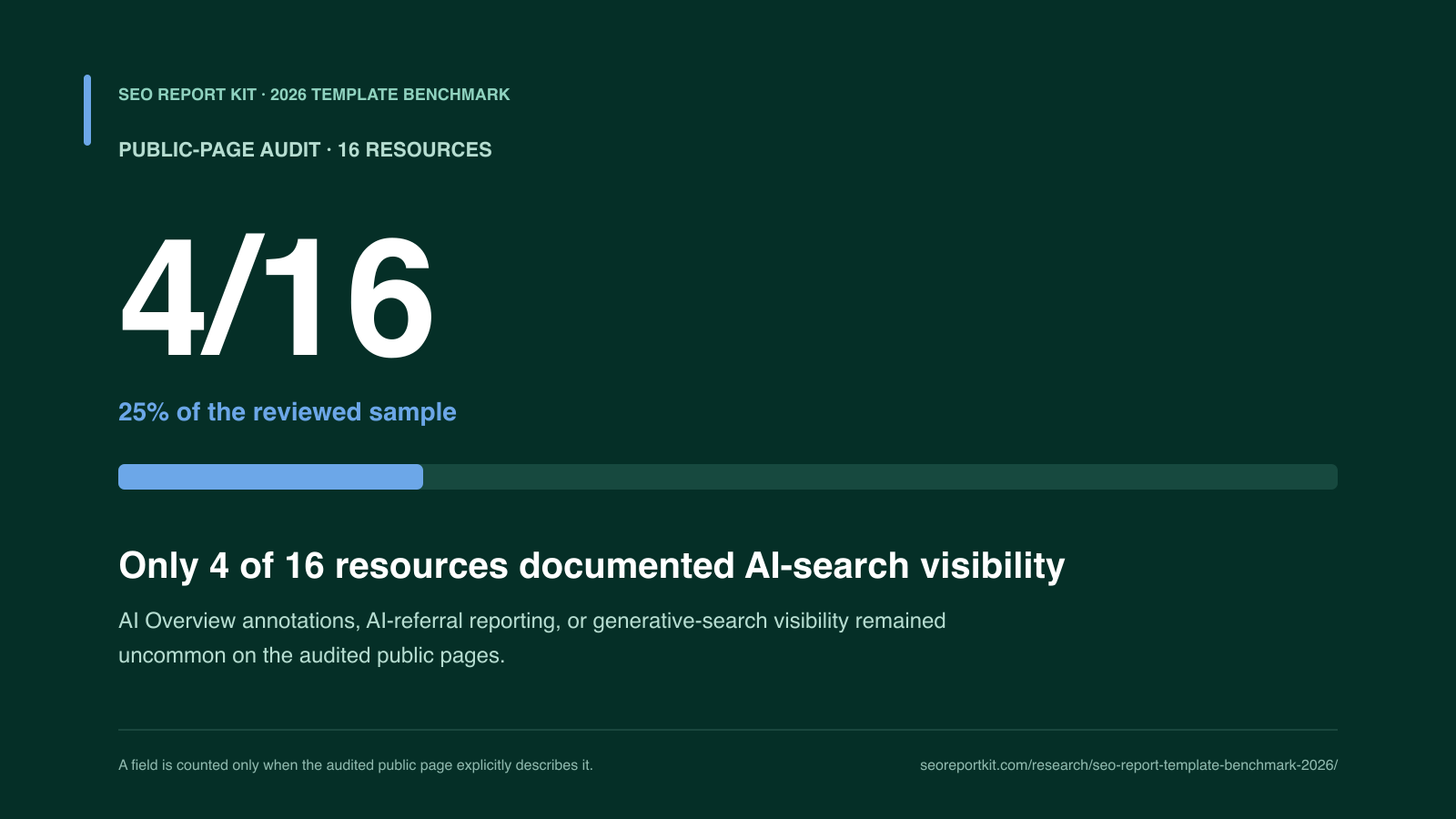
Four of the 16 public resources mention AI-search visibility, AI Overview annotations, AI-referral traffic, or generative-search reporting. Only two explicitly describe a confidence, limitation, risk, or data-integrity field. These are different concepts, but both matter when search reporting moves beyond stable web analytics: AI answers vary by engine, date, location, and session, while source changes and tracking discrepancies can make period comparisons unreliable.
A responsible report should not turn one sampled AI answer into a permanent ranking claim. It should record the prompt, engine, region or persona, observation date, cited URL, and a caveat about sampling. The same principle applies to conventional metrics when attribution rules or tracking implementations change. The benchmark therefore treats explicit caveat language as a structural feature, not as optional legal copy.
Methodology and coding rules
The sample covers 16 English-language public pages offering or documenting a reusable SEO report template, dashboard, workbook, presentation deck, or reporting framework. One representative resource was selected per product, except Semrush, where its My Reports product template and its separately gated Academy workbook are materially different offers. Pages were reviewed on July 10, 2026. The unit of analysis is the public resource page, not the complete private product.
Each binary field receives yes only when the public page explicitly states that the resource includes it. A no means not publicly documented under this rule; it does not prove the feature is absent after login. Access model records the first meaningful gate before a visitor can copy, download, or use the reusable artifact. Evidence notes paraphrase the relevant public claims and limitations. No private account screenshots or copied interfaces are included in the dataset.
How to reuse the data without overstating it
Use the CSV to compare field prevalence, map access friction, or create your own visualization. Keep the sample size, review date, and public-page scope beside any aggregate. Link to the publisher's original page when discussing one resource, and link to this benchmark when citing the compiled result or method. The evidence column is intentionally short; re-open the source before making a purchasing decision because landing pages can change after the audit date.
This is a purposive market sample, not a census of every SEO report template and not a hands-on product ranking. It does not evaluate design quality, connector accuracy, customer support, pricing value, or features hidden behind an account. It also weights every public resource equally rather than by market share. Those limits make the study appropriate for understanding public positioning and visible workflow coverage, but not for declaring one product universally best.
Evidence ledger
Public sources and coding notes
Open the source before making a product decision. These notes describe what was visible on the audited page on July 10, 2026.
AgencyAnalytics: Free SEO Report Template
Automated dashboard and PDF · Trial required
The public page describes an executive-ready summary, KPI and goal sections, reporting periods, scheduled delivery, and a 14-day product trial; it does not describe owners, approvals, or a confidence field.
DashThis: Monthly SEO Report Template
Automated dashboard and PDF · Trial required
The page exposes a live sample, named KPI groups, an executive summary with a next-month action, scheduled cadence, and a 15-day trial; no work log, owner, approval, or caveat field is stated.
Whatagraph: SEO Report Template
Automated dashboard and PDF · Publisher account
The public page names performance-summary, KPI, period, graph, and next-step requirements and instructs users to create an account and connect sources; governance fields are not described.
MetricNexus: Looker Studio SEO Report Template
Looker Studio dashboard · Google account
The guide documents demo-data replacement, date ranges, an executive version, opportunities, tracking discrepancies and limitations, plus a separate AI-referral channel; copying requires a Google account.
SEOJuice: SEO Report Template 2026
Google Sheets, Excel, and PDF · Direct download
The no-email download explicitly includes sample data, month-over-month deltas, an executive cover, actions taken and planned, and reporting-period comparisons; ownership and approval are not listed.
PikaSEO: Monthly SEO Report Template
Excel workbook · Direct download
The page offers a no-signup XLSX and describes a summary, month-over-month KPI comparison, completed work, priorities, next steps, and sample rows; owner and approval controls are absent.
Searcle AI: Universal SEO Report Template Pack
Looker Studio, Sheets, Slides, and PDF · Direct download
The free pack describes an executive deck, risks, next actions, owner and ETA, source labels, QA and data-integrity notes, AI Overview annotations, and a filled sample report; no approval stage is stated.
Notion Marketplace: SEO Reporting by mrpugo
Notion workspace · Publisher account
The marketplace description names executive dashboards, work breakdown, cadence, accountability, timelines, and a draft-to-review-to-sent pipeline; the template requires a Notion account.
Rows: SEO Report Template for Agencies
Connected spreadsheet · Publisher account
The page documents an overall summary, date range, KPI pages and recommendations, then requires a Rows account plus GSC and GA4 connections; workflow ownership and caveats are not specified.
Piped Out: Free SEO Looker Studio Dashboards
Looker Studio dashboards · Google account
Two public Looker Studio examples cover quick summaries, period comparison, rank buckets, winners, losers and targets; copying or configuring the reports requires Google access.
Semrush My Reports: Monthly SEO Report
Automated report and PDF · Publisher account
The product template lists SEO KPI, traffic, conversion, keyword, link and technical-health modules, date-based automation and AI summaries; use requires a Semrush account.
Swydo: SEO Report Template
Automated dashboard and PDF · Trial required
The public template describes an executive summary, next steps, reporting periods and AI Overview or SERP-feature tracking, with access through a 14-day product trial.
Databox: SEO Dashboard Templates
Automated dashboards · Publisher account
The gallery documents more than 25 connected SEO dashboards with historical periods and KPI views; the public page does not promise a narrative summary, work log, owners, approvals, or caveat field.
Beautiful.ai: SEO Report Presentation Template
Presentation deck · Trial required
The deck includes strategy, KPI, deliverable-status, conclusions and next-step slides, but the public page does not describe an executive summary, date-source ledger, ownership, approval, or caveat structure.
Semrush Academy: SEO Report Template by TrioSEO
Customizable workbook · Publisher account
The public Academy page promises customizable keyword, ranking and traffic tracking, but hides the download behind login and does not describe the remaining workflow or governance fields.
HubSpot: How to Create an SEO Report
Guide and illustrated report framework · Guide only
The 2026 guide documents a title and summary, defined period, completed activities, strategic next steps, business KPIs and AEO visibility, but it offers a framework and screenshots rather than a reusable file.
Read this result as a public-page audit
A field is coded yes only when the public page explicitly says the resource includes it. Features that may exist behind login but are not described publicly remain no for this audit. A no therefore means not publicly documented in this audit, not proven absent from the private product.
Cite and reuse
A fixed release for reproducible references
Use the versioned release when you need a stable research citation. Link to this page when readers need the methodology, complete source ledger, and current presentation.
Suggested citation
SEO Report Kit. (2026). SEO Report Template Benchmark 2026 (Version 1.0.0) [Data set]. Zenodo. https://doi.org/10.5281/zenodo.21369737
Benchmark questions
What exactly was benchmarked?
We reviewed 16 English-language public pages that offer or document a reusable SEO report template, dashboard, workbook, deck, or reporting framework. The audit codes what each public page explicitly promises, not every feature that may exist after login.
Does a no mean a product does not have that feature?
No. A no means the reviewed public page did not explicitly document the field under the conservative coding rule. The feature may exist inside the product or on another page, which is why every row includes its exact source and an evidence note.
Why are access requirements included?
Access friction determines whether a visitor can inspect and reuse the artifact before creating an account or starting a trial. It is reported separately from workflow coverage and is not treated as a quality score.
Can I download and reuse the benchmark data?
Yes. The complete 16-row dataset is available as CSV. Keep the July 10, 2026 review date, the sample size, and the public-page scope with any chart or aggregate, and link to this page for the method.
Is this a recommendation or product ranking?
No. The benchmark compares visible access and reporting fields. It does not score connector accuracy, private product features, support, price, or overall design quality, so it should not be presented as a universal best-tools list.
How should a publisher request a correction?
Send the exact source URL and the public wording that supports a different code. Clear factual errors can receive a dated correction; normal landing-page changes belong in a future edition so this snapshot remains auditable.