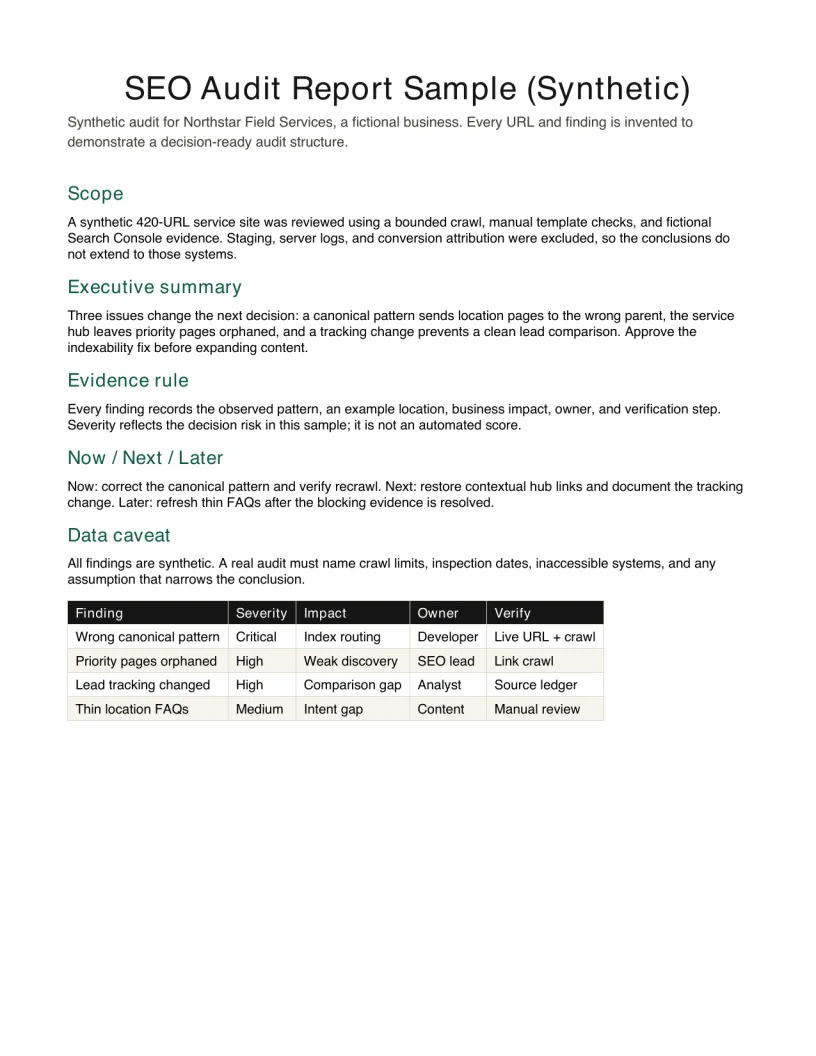
 Actual first page · synthetic PDF
SEO audit report sample
This synthetic report shows a client-facing audit with scoped findings, severity, business impact, owners, and a phased roadmap. It includes scope and evidence boundary, prioritized findings, owner-ready roadmap and can be downloaded as a PDF. Use it as a structural reference, not as real client data. Use when a one-off site review must end in an implementation decision.
- Best for
- Use when a one-off site review must end in an implementation decision.
- File
- Complete PDF with a real first-page preview
- Boundary
- Fictional business and synthetic evidence; not a case study or site performance
- Next step
- Replace the structure with verified inputs in the matching template or generator
What this audit report sample demonstrates
This worked SEO audit report is a synthetic client deliverable, not an automated site score. It shows how a reviewer can move from a bounded crawl and manual checks to a short set of defensible findings. The fictional site, Northstar Field Services, has a mix of service pages, location pages, and editorial resources. Every URL, metric, and outcome in the PDF is invented to demonstrate structure; none describes a real company.
The report is built around decisions. It names the audit scope before presenting findings, separates observed evidence from business impact, and gives every recommended fix an owner and definition of done. That makes it different from a checklist of pass/fail items: a client can see what was inspected, what remains uncertain, which issue matters first, and what evidence should prove the implementation worked.
The evidence-to-roadmap structure
The first page carries the decision surface: scope, three material findings, the main data limitation, and the approval needed from the client. Detailed findings then use a fixed chain of observation, example URL, severity, business impact, recommended action, owner, and verification. Keeping those fields together prevents a generic best-practice statement from being presented as if it were a verified defect.
The roadmap groups work into Now, Next, and Later. Now contains indexability or measurement blockers that can invalidate the rest of the analysis. Next contains improvements supported by the audit evidence but not urgent enough to interrupt current work. Later holds experiments and maintenance tasks. Effort is described as a delivery size rather than an invented hour estimate, because the real estimate depends on the site's stack and review process.
- Scope records the crawl date, sample size, exclusions, and named data sources.
- Findings distinguish evidence from impact and include a real example location.
- The roadmap assigns one owner and one observable definition of done.
- Caveats remain visible beside the conclusion instead of being buried in an appendix.
Fields in the sample audit
Use the field map below as a quality check when adapting the PDF. A severity label is only useful when the report also explains the affected decision. Likewise, an example URL is not proof that every page has the same issue; record the pattern, the sample method, and any pages that were not checked.
| Field | Purpose | How to use it |
|---|---|---|
| Observed evidence | The verified condition behind a finding. | Name the pattern, date, sample method, and an example location without claiming the whole site was checked. |
| Severity and impact | Why the issue changes a business decision. | Explain the consequence before assigning severity; do not use a score as a substitute for evidence. |
| Owner and action | The person and bounded fix. | Assign one accountable owner and describe the specific implementation rather than a generic best practice. |
| Definition of done | The evidence that closes the finding. | Name the live check, crawl result, or finalized reporting signal expected after implementation. |
Turn the sample into a real audit deliverable
Start with the editable audit workbook and replace every synthetic row with a finding you personally verified. Preserve the evidence field even if the client only receives a short PDF; it is the audit trail that lets another reviewer reproduce your conclusion. Then use the audit checklist generator to establish scope and ownership, and move only the approved actions into the client report generator for the next reporting cycle.
Before delivery, recheck the live examples, remove any unsupported causal language, and name every data source and date range. If a crawl was partial, a staging environment was inaccessible, or analytics changed during the review, state it plainly. An honest limitation narrows the conclusion; it does not make the audit weaker.
SEO audit report sample FAQ
Is this SEO audit report based on a real client?
No. The company, URLs, findings, and metrics are synthetic. They exist only to show how a finished audit report can connect verified evidence to severity, ownership, and a phased roadmap without exposing client data.
How is an audit report sample different from an audit template?
The sample shows a completed narrative with fictional evidence and decisions. The template is the editable workbook you fill with your own crawl results and manual checks. Use the sample for structure and tone, then build the real deliverable in the template.
Should every SEO audit use an overall score?
No. A score can help summarize a repeatable methodology, but it can also hide a critical blocker inside an average. This sample leads with specific findings and business impact; if you add a score, disclose the weighting and keep critical issues visible.
What evidence should an audit finding include?
At minimum, name what was observed, where it was observed, how the sample was selected, and how another reviewer can verify it. Add the crawl or inspection date and keep uncertainty explicit when the evidence does not cover the full site.
Can I send this PDF directly to a client?
Use it as a teaching reference, not as the client's audit. Download the editable audit workbook, replace all synthetic content with verified findings, remove anything you did not inspect, and review ownership and priorities with the delivery team before sending.